
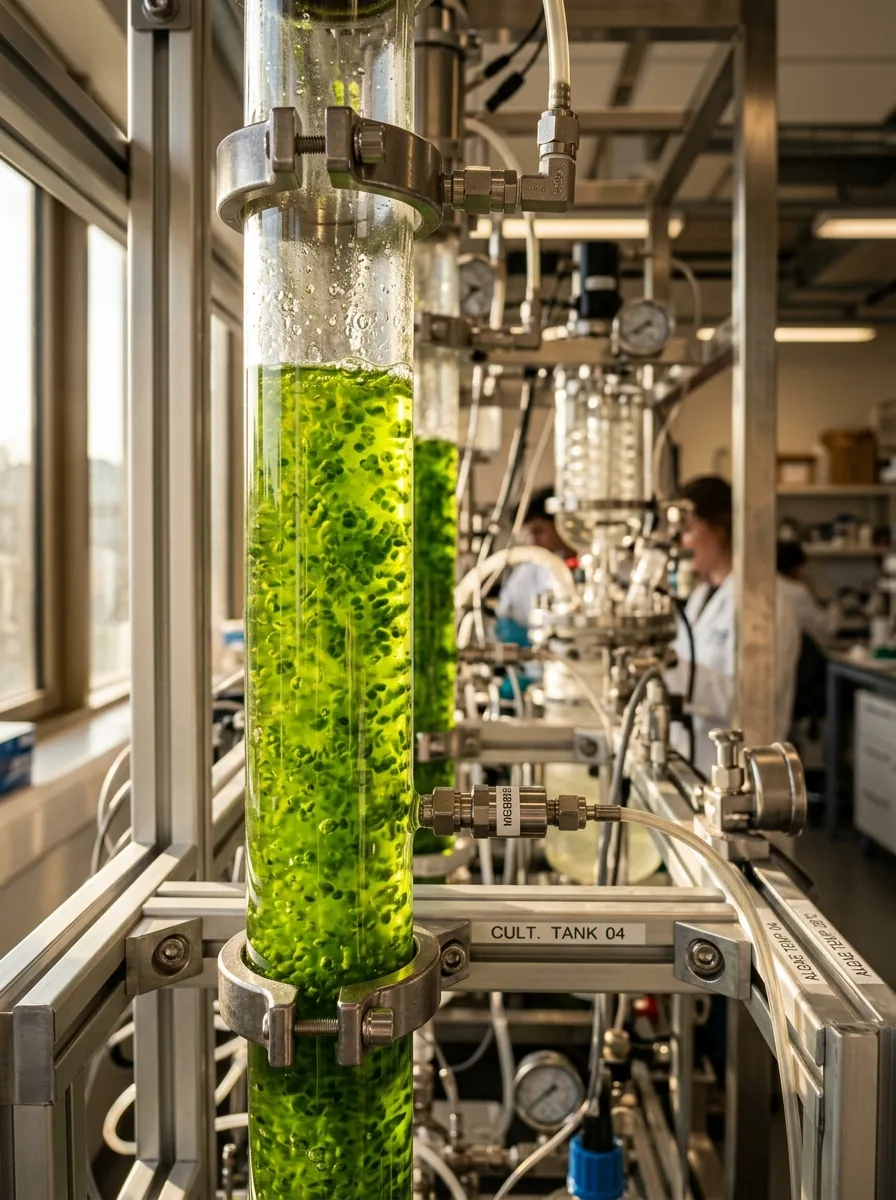
Microalgae are one candidate feedstock for future renewable fuels and materials. The hard question is not whether algae can produce useful compounds in a laboratory—it is whether a responsible process can become efficient and repeatable outside one.
At PT Gapah Lantas Baharu (LANTAS), that validation gap is where we focus.
The Problem with Crop-Based Biofuels
Crop-based biofuels can create difficult trade-offs when they depend on fertile land, food commodities, or ecosystem conversion:
-
Food versus fuel: Diverting crops or productive land can put pressure on food systems.
-
Land conversion: Feedstock expansion can put pressure on forests and other valuable ecosystems.
-
Resource intensity: Water, fertilizer, processing energy, and transport all affect the real environmental result.
Why Microalgae Is Interesting
1. Lipid potential
Some microalgae can accumulate lipids that may serve as inputs for fuels or renewable materials. Actual productivity depends on strain, cultivation conditions, harvesting, and downstream processing.
2. Different cultivation environments
Microalgae can be cultivated in controlled systems that do not require fertile soil. Whether a site truly avoids competition with agriculture still depends on its water, nutrient, energy, and land requirements.
3. Rapid growth
Many microalgae grow faster than terrestrial crops. Turning that biological advantage into stable output requires careful control of contamination, climate, nutrients, and harvesting.
4. Carbon use
Microalgae use carbon dioxide during photosynthesis. A credible carbon claim, however, must account for cultivation energy, inputs, processing, transport, and what ultimately happens to the carbon in the product.
LANTAS's Focus
Our research begins with locally relevant microalgae and tropical operating conditions in Jambi, Indonesia. Specific biological materials, cultivation protocols, and performance data are not part of our public profile; they are shared with qualified collaborators when appropriate.
Moving from Laboratory to Field
The challenge lies in total system efficiency: cultivation, harvesting, extraction, safety, and consistent quality. LANTAS is currently in applied R&D and early validation; commercial scale is a goal to be tested, not a result we claim today.
Conclusion
The future of biofuel cannot rely on destruction. Microalgae deserve disciplined investigation as one possible route—not exaggerated promises. Our job is to find where the biology, process, and local economics genuinely work together.